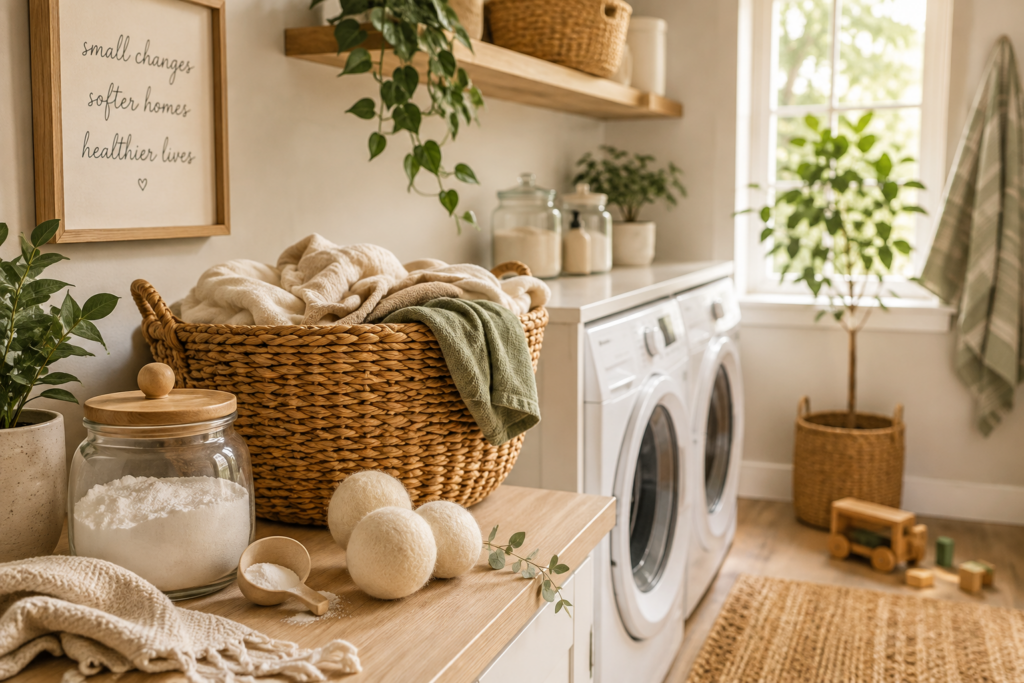
Creating a lower-tox laundry routine doesn’t have to mean replacing everything in your laundry room overnight. A few thoughtful swaps can help simplify your routine while cutting back on ingredients you may prefer to avoid—and you can start with what makes sense for your family and budget.
Affiliate Disclosure: This post contains affiliate links, which means I may earn a small commission if you make a purchase through one of my links, at no additional cost to you. I clearly distinguish between products I’ve personally used and products I’m sharing based on research. As an Amazon Associate I earn from qualifying purchases.
When I started making changes in my own home, laundry was one of the areas I kept coming back to. Between detergent, stain removers, scent boosters, dryer sheets, and all the extras, there are a lot of products involved in something we do every week. But I’ve learned that a simpler laundry routine can still work really well.
In this guide, I’m sharing the products, DIY options, and simple swaps I use or recommend for building a more practical lower-tox laundry routine—without making laundry any more complicated than it already is.
What Does “Lower-Tox Laundry” Actually Mean?
When I say “lower-tox,” I’m not talking about creating a perfectly toxin-free home. For me, it simply means being more intentional about the products I bring into my home and looking for simpler options when they make sense.
With laundry, that might mean choosing a fragrance-free detergent, skipping products you don’t really need, trying a simpler stain treatment, or making your own laundry products at home. You don’t have to change everything at once. Even one swap can be a good place to start.
Step 1: Start With Your Laundry Detergent
If you only want to make one change to your laundry routine, detergent is an easy place to start. It’s something most of us use with every load, so finding an option that works for your household can simplify everything else.
I like to look for laundry detergents with straightforward ingredient information and fewer extras I don’t necessarily need. Fragrance-free options can also be a great choice if you’re trying to reduce added fragrance in your laundry routine.
Ready-Made or DIY? Both Can Work.
I’ve made my own laundry detergent for quite a while, so DIY has become a normal part of my laundry routine. But I also know that making detergent isn’t realistic for everyone—or even for me all the time! Having a ready-made option on hand can make things much easier during busy weeks.
More recently, I tried Molly’s Suds Unscented Laundry Powder as a ready-made option. I like that it has a short, straightforward ingredient list and no added fragrance or essential oils. It gives me another option when I don’t have the time (or energy!) to make a batch of detergent myself.
Step 2: Consider Making Your Own Laundry Detergent
Making my own laundry detergent was actually one of the swaps that became a regular part of my routine. I started doing it because I liked knowing exactly what I was putting into each batch, and I liked being able to make detergent at home instead of constantly buying another bottle.
DIY laundry detergent can also be surprisingly simple. You don’t need a laundry room full of ingredients or complicated equipment. My routine uses just a handful of basic ingredients, and once I got used to making it, it became one of those household tasks that felt pretty normal.
My DIY Laundry Detergent Routine
I usually make my laundry detergent at home, and over time I’ve found a routine that works well for my household. I use a small number of basic laundry ingredients and make enough at once so I’m not constantly mixing up a new batch.
I’ll be sharing my full DIY laundry detergent recipe in a separate post, including the ingredients I use, how I make it, and some of the changes I’ve made as I’ve learned more about the products and ingredients I bring into my home.
Step 3: Treat Stains Before Rewashing
Treating a stain before rewashing can help avoid running an entire extra wash cycle unnecessarily. The best approach will depend on the stain, the fabric, and the laundry products you’re comfortable using.
This is actually an area of my lower-tox laundry routine that I’m still experimenting with. I’ve been researching simpler stain removers and laundry boosters, but I don’t want to recommend something here as a personal favorite until I’ve actually used it myself.
Step 4: Skip the Extras You Don’t Need
Building a lower-tox laundry routine isn’t only about finding replacements for the products you already use. Sometimes the simplest swap is realizing you may not need a replacement at all.
Traditional laundry routines can include detergent, fabric softener, scent boosters, dryer sheets, stain treatments, and more. I’ve found that simplifying the number of products I use makes laundry easier while also helping me be more intentional about what I bring into our home.
What About Fabric Softener and Dryer Sheets?
Instead of automatically replacing every laundry extra with a “cleaner” version, I like to ask whether it serves a purpose in my routine first. For example, reusable wool dryer balls can be a simple alternative to single-use dryer sheets for helping separate clothes as they tumble in the dryer.
Step 5: Make Changes Gradually
You don’t need to overhaul your entire laundry routine in one weekend. In fact, I think making changes gradually can make the process feel much more manageable—and it gives you time to figure out what actually works for your household.
Use what you already have, replace products as you run out, and start with the swaps that matter most to you. Your lower-tox laundry routine doesn’t have to look exactly like mine or anyone else’s. The goal is simply to make more intentional choices that fit your home, your budget, and your life.
Your Lower-Tox Laundry Starting Point
Not sure where to begin? Keep it simple. You can start with these four steps:
- Choose a detergent that fits your priorities.
- Simplify the laundry extras you don’t really need.
- Create a simple plan for treating stains.
- Make changes gradually instead of replacing everything at once.
That’s it. You don’t need a perfectly “non-toxic” laundry room to make meaningful changes. Start where you are, choose what makes sense for your family, and let your routine evolve as you learn what works for you.
I’m still learning and experimenting with my own laundry routine, too, and I’ll continue sharing the products, DIY recipes, and swaps that are genuinely working in our home along the way.